
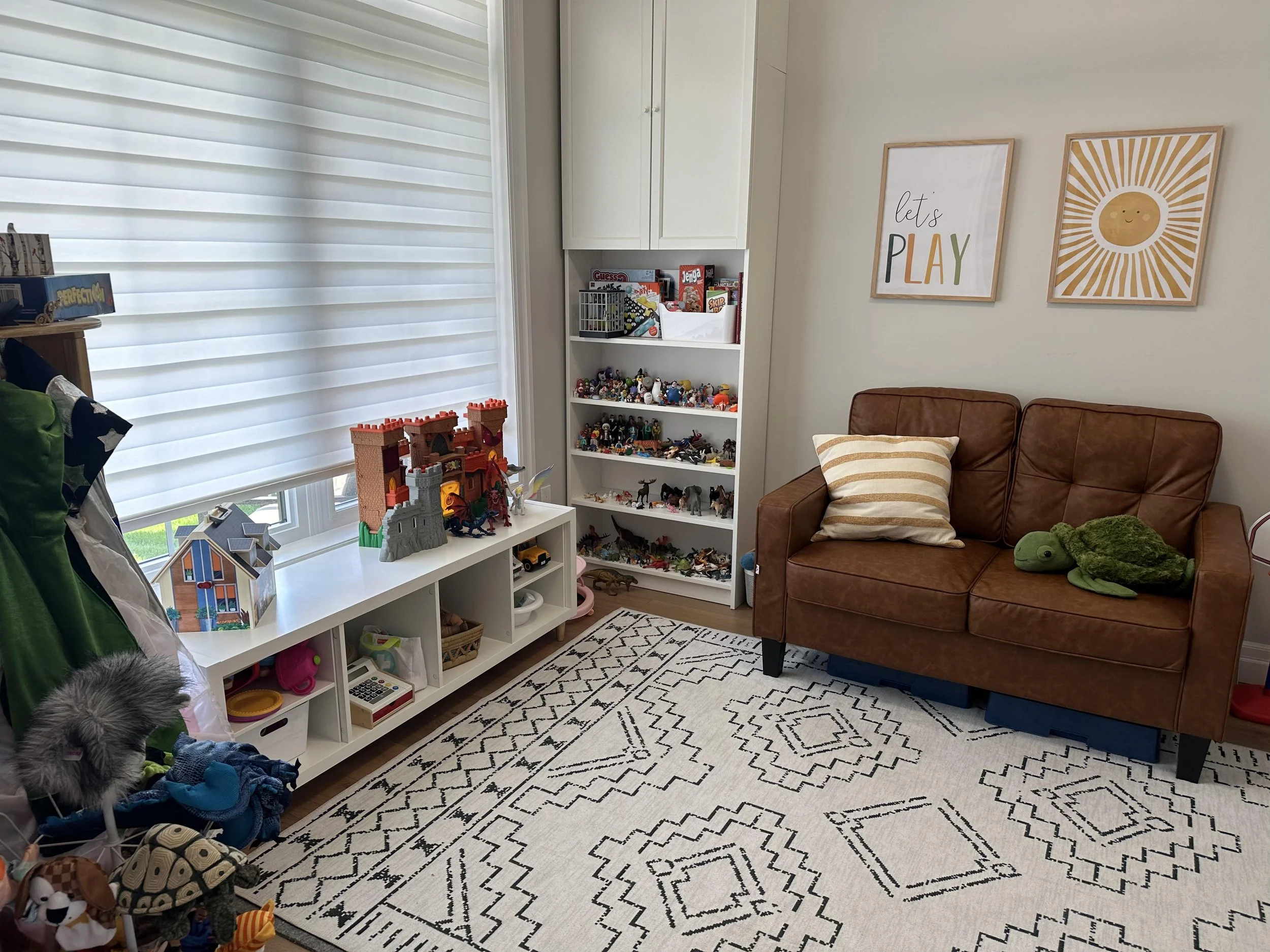
A welcoming space for child-centred play therapy at Courageous Counselling and Play Therapy in St. Thomas, Ontario.
Have you ever found yourself having a much bigger reaction to your child's behaviour than you expected?
Maybe your child is whining, refusing to listen, yelling, arguing, or having a meltdown. You know they are having a hard time, and you want to respond calmly. But something about the moment feels especially difficult. You feel frustrated, overwhelmed, angry, or completely flooded.
Later, when things have settled, you might wonder:
Why did I react that way? Why was that so hard for me?
Sometimes, our reactions to our children have as much to do with our own experiences growing up as they do with what is happening in the moment.
Becoming a parent can bring parts of our own childhood back into focus. The way we were parented, the expectations placed on us, and the emotions we were or were not allowed to express can all influence how we respond to our own children.
This doesn't mean you're a bad parent. It means there may be something worth understanding beneath the reaction.
Why Does My Child’s Behaviour Trigger Me?
A child's behaviour can trigger strong emotional reactions in parents when it brings up feelings, expectations, or experiences from their own childhood. For example, a child's anger, crying, defiance, or need for reassurance may activate familiar stress responses based on how a parent was raised. Understanding these triggers can help parents recognize what is happening beneath their reactions and respond to their children with greater awareness and connection.
Children have a way of bringing us face-to-face with feelings and experiences we may not even realize we are carrying.
Have you noticed that certain behaviours seem to get under your skin more than others? Perhaps your child's whining, crying, yelling, refusal to listen, or need for reassurance brings up a level of frustration or overwhelm that surprises you.
You might find yourself reacting more strongly than you intended, feeling an urgent need to stop the behaviour, or struggling to stay calm even when you know your child is having a hard time.
Sometimes, these reactions are connected to more than what is happening in the moment.
You might notice yourself thinking:
"I would never have gotten away with that."
"Why can't they just listen?"
"They need to learn that this isn't okay."
"I don't understand why everything has to be such a big deal."
Or perhaps you have made a conscious decision to parent differently from the way you were parented. You want your child to feel heard, understood, and supported, but you still find certain moments incredibly difficult.
These reactions can leave parents feeling confused or discouraged, especially when they are trying so hard to respond differently.
How Your Own Childhood Experiences Can Affect Your Parenting
We all bring our own histories into parenting.
The way we were parented, the expectations placed on us, and the experiences we had growing up can shape how we understand children's behaviour and emotions.
For some parents, growing up meant learning that children should be quiet, cooperative, respectful, and listen to adults without questioning them. Perhaps expressing anger, crying, talking back, or disagreeing was not accepted. You may have learned to keep difficult feelings to yourself, avoid conflict, or manage things independently.
Without even realizing it, you might find yourself carrying some of those same expectations into your parenting.
When your child expresses anger or frustration, you may experience it as disrespectful or unacceptable rather than recognizing it as a child having a difficult time managing a big feeling.
Or perhaps your child needs a lot of reassurance, has difficulty separating from you, or struggles with transitions. If you grew up needing to be independent or were expected to manage things on your own, these needs might feel particularly challenging to respond to.
For other parents, the impact can look different. You may have spent years thinking about the kind of parent you wanted to be and made a conscious effort to offer your child something different from what you experienced growing up. And yet, certain situations can still bring up familiar feelings or reactions.
This doesn't mean you are intentionally repeating the past. Often, these responses happen quickly and automatically.
You may know, intellectually, that your childhood experiences have influenced you. But recognizing that our past has affected us and understanding how it shows up in our parenting are two different things.
Why Understanding Your Own Triggers Matters
When parents initially seek support, much of the focus naturally begins with the child.
What is happening? Why are they behaving this way? How can we help them manage their emotions? What can we do differently when challenging behaviours occur?
These are important questions. Understanding your child's behaviour through a developmental lens can make a meaningful difference in how you respond.
But there is another part of the picture that deserves attention: what is happening for you as the parent?
What happens inside you when your child becomes upset? What feelings come up? Are there particular behaviours or situations that feel harder to be with than others?
Sometimes, we become so focused on wanting our child's behaviour to change that we don't stop to consider why that behaviour is so difficult for us in the first place.
Parent support can provide space to explore these questions without judgment. It isn't about blaming parents for their reactions or suggesting that everything comes from their childhood. It's about developing a better understanding of the experiences, beliefs, stressors, and nervous system responses that influence how we show up in our relationships.
As we begin to understand ourselves more fully, we can often develop greater compassion for our own experiences. We may start to recognize what activates us, what happens in our bodies when we're overwhelmed, and what we need to feel more grounded.
This awareness can create more room between what our child does and how we respond.
How Your Nervous System Influences Your Child's Experience
Parenting can be especially challenging when both you and your child are having a hard time at the same time.
Children rely on the adults around them for support as they learn to understand and manage their emotions. Their ability to regulate is still developing, and they often need help from a connected adult when feelings become too big.
But what happens when your child's distress activates your own nervous system?
Imagine you grew up in a home where expressing anger, talking back, or showing frustration was not accepted. You may have learned that these behaviours were disrespectful or needed to be stopped quickly.
Now, when your child becomes angry, yells, or refuses to cooperate, you might notice an immediate reaction. Your body becomes tense. Your frustration rises. You feel an urgent need to regain control of the situation.
You may understand that your child is still learning to manage big emotions, but in that moment, it can be difficult to access that understanding. Your nervous system may move into a heightened state of stress, making it harder to pause, think clearly, and stay connected.
When this happens, your child is also experiencing your response. A tense voice, increased frustration, or a sense of disconnection can add to an already difficult moment.
This doesn't mean parents need to be calm all the time. That's not realistic, and it isn't what children need. What matters is developing the awareness and capacity to recognize when we're becoming overwhelmed and learning how to reconnect when things get difficult.
As parents better understand their own triggers and nervous system, they may find it easier to stay present with their child's emotions and offer support through difficult moments. This creates more opportunity for co-regulation: the process of being supported by another person as we work through our feelings.
You may also find it helpful to learn more about emotional dysregulation in children and how parents can help.
What If Understanding Your Triggers Isn't Enough?
Sometimes, learning about your nervous system, exploring your childhood experiences, and developing more awareness through parent support can make a meaningful difference.
Other times, a parent's reaction feels so strong that understanding it isn't enough to help them stay grounded.
You might recognize that your child's behaviour is developmentally normal. You might know that they need connection rather than correction. You might even understand where your reaction comes from. And yet, when the moment happens, you still feel flooded.
Perhaps a particular tone of voice, expression, behaviour, or emotional response brings up an intense feeling that seems difficult to manage. You may find yourself reacting before you have time to think, or feeling as though you are right back in an old experience.
When this happens, individual counselling or trauma-focused therapy may be worth exploring.
Could EMDR Be Helpful?
One approach that may be helpful for some people is Eye Movement Desensitization and Reprocessing (EMDR).
EMDR is an evidence-based psychotherapy that can help people process distressing memories and experiences that continue to affect how they feel and respond in the present.
For some parents, unresolved experiences from childhood may contribute to the intensity of their reactions today. EMDR may offer an opportunity to process some of those experiences and lessen the distress they bring up in the present.
Parent support and individual therapy offer different kinds of support. Parent support can help you understand your child's needs, recognize your own triggers, and build practical ways to navigate challenging moments. Individual therapy can provide space to work through personal experiences that may be contributing to your distress. Sometimes, both may be helpful.
REM Therapy Services is a practice specializing in trauma therapy, including traditional EMDR sessions and more intensive treatment options. They offer in-person appointments in Markham and virtual therapy across Ontario.
If you're interested in exploring this approach, you can learn more about EMDR therapy and trauma treatment at REM Therapy Services.
EMDR may be an option worth discussing with a qualified therapist if you feel that past experiences are continuing to affect you.
You Aren't a Bad Parent Because You Have Triggers
If you recognize yourself in any of this, I hope you can take away a few things.
You aren't a bad parent because your child's behaviour triggers you.
Your childhood experiences deserve compassion and attention, too.
Understanding your own nervous system is just as important as understanding your child's.
You don't have to figure everything out alone. There are different kinds of support available.
Frequently Asked Questions
Why does my child make me so angry?
Sometimes, a child's behaviour brings up feelings, expectations, or experiences from a parent's own childhood. Certain behaviours, such as crying, yelling, defiance, or refusing to cooperate, may activate strong emotional responses that feel bigger than the situation itself. Stress, exhaustion, and the demands of parenting can also contribute to feeling overwhelmed.
Can my childhood affect the way I parent?
Yes. Experiences from your own childhood can influence your expectations of children, your responses to difficult emotions, and the way you handle conflict. Even when you consciously want to parent differently, certain situations can bring up familiar emotional responses.
How do I stop reacting to my child when I'm overwhelmed?
Learning to recognize your triggers and the signs that your nervous system is becoming overwhelmed can be an important first step. With greater awareness, you can begin developing strategies to pause, regulate your own emotions, and reconnect with your child after difficult moments. Parent support can provide a space to explore these patterns and develop practical ways to respond.
Can therapy help with parenting triggers?
Yes. Parent support can help you understand your child's behaviour, recognize your own emotional triggers, and develop more confidence in navigating challenging parenting moments. If past experiences are contributing to intense emotional reactions, individual counselling or trauma-focused therapy may also be helpful. Sometimes, both types of support can complement one another.
Support for You and Your Child
At Courageous Counselling and Play Therapy, parent support offers caregivers a space to better understand their child's behaviour, explore their own experiences, and build greater confidence in navigating the challenging moments of parenting.
Sometimes, supporting your child begins with making space to understand yourself, too.
If you're looking for support with your child's big emotions, challenging behaviours, or your own experiences as a parent, you can learn more about parent support services at Courageous Counselling and Play Therapy.
About the Author
Kristi Forbes is a Registered Psychotherapist (RP) and Certified Play Therapist (CPT) with a Master's degree in Counselling Psychology. Through Courageous Counselling and Play Therapy, she provides child-centred play therapy for children ages 3–12 in St. Thomas and the surrounding London, Ontario area, as well as virtual parent support to families across Ontario.